Water-Saving Toilet Technology: How Dual Flush Systems Cut Water Use
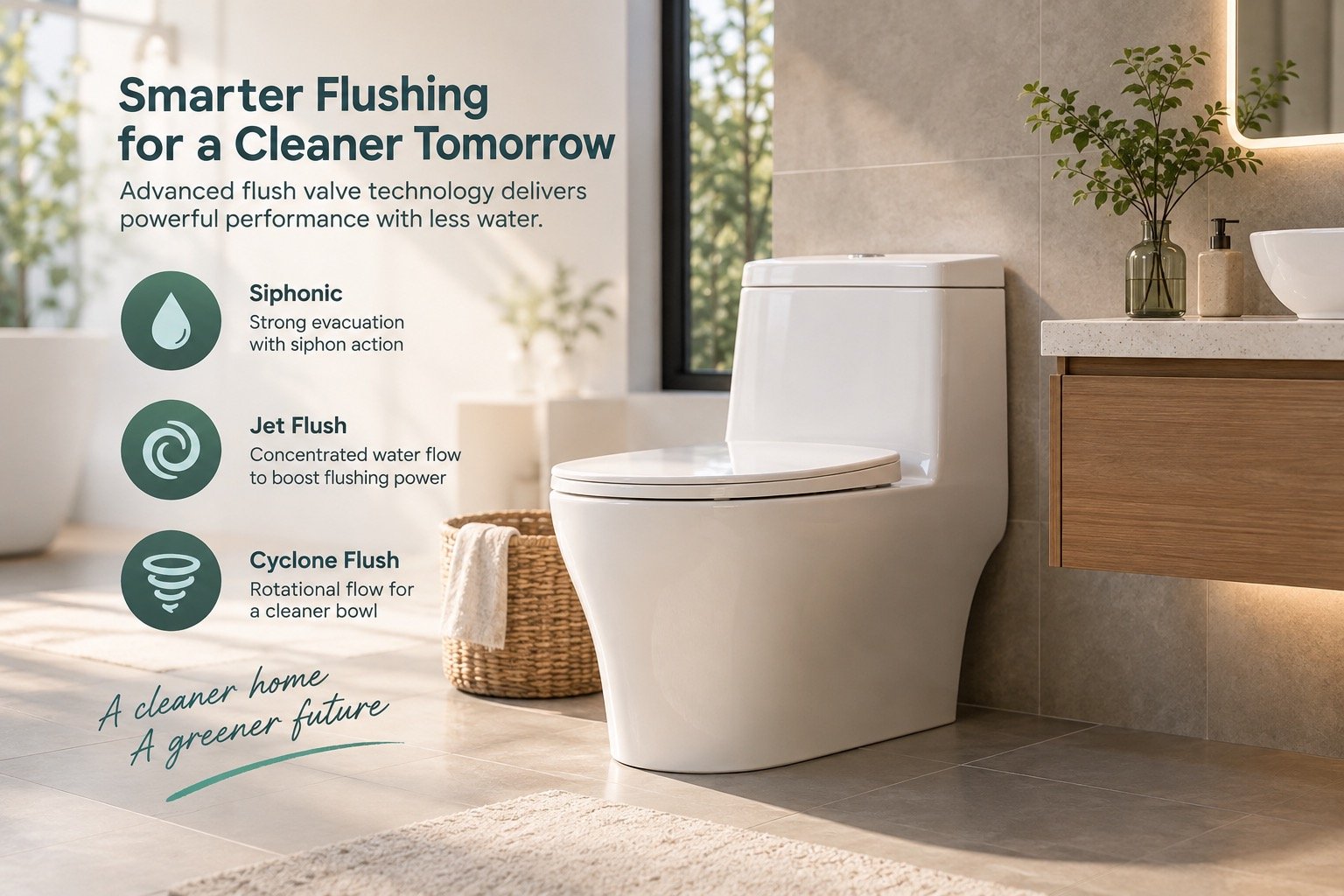
Toilets are consistently one of the largest sources of indoor water use in any home, which is why flushing technology has become a real focus of engineering innovation rather than an afterthought. Dual flush systems — now standard on many modern toilets — offer a simple idea with a meaningful payoff: give users the choice between a smaller flush for liquid waste and a larger flush for solid waste, instead of using the same volume of water every time. Over the course of a year, that small choice adds up to a significant reduction in household water consumption. Here’s how the technology works, how much water it actually saves, and what current efficiency standards mean for choosing a toilet today.
IN THIS GUIDE
Why toilet water use matters · How dual flush technology works · Water use comparison by toilet type · The updated WaterSense standard · Estimated household savings · Choosing a reliable water-saving toilet · FAQ
Why Toilet Water Use Matters
Flushing accounts for roughly 30% of an average household’s total indoor water use, more than any other single fixture in most homes. With a typical person flushing several times a day, even a modest reduction per flush translates into a large volume of water saved over weeks, months, and years. This is why toilets have become a primary target for water efficiency regulations and product innovation — the potential for savings, multiplied across millions of households and commercial buildings, is enormous.
How Dual Flush Technology Works
A dual flush toilet uses a tank valve and flush mechanism designed to release two different water volumes depending on which button or lever position is used. Pressing the smaller button releases a reduced volume of water intended for liquid waste, which requires less force to clear the bowl. Pressing the larger button triggers a fuller flush with more water and greater flow force, suited to clearing solid waste effectively. The mechanism itself is usually a specially designed flush valve or flapper that can open to two different degrees or durations, rather than a single fixed opening as in a conventional single-flush toilet.
Water Use by Toilet Type
Flushing volume has dropped dramatically over the past several decades as regulations and technology have advanced. The table below shows how older and newer toilet types compare:
| Toilet Type | Typical Water Use |
|---|---|
| Older toilets (pre-1990s) | 3.5–7 gallons per flush |
| Current U.S. national standard | 1.6 gallons per flush |
| WaterSense-certified single flush | 1.28 gallons per flush or less |
| Common dual flush | 1.1 gpf (liquid) / 1.6 gpf (solid) |
| High-efficiency dual flush | 0.8 gpf (liquid) / 1.28 gpf (solid) |
Compared to an older high-volume toilet, even a standard dual-flush model can cut water use by more than half, while a high-efficiency dual-flush model can reduce consumption even further without sacrificing flushing reliability.
The Updated WaterSense Standard for Dual Flush Toilets
Water efficiency standards continue to evolve. The EPA’s WaterSense specification for tank-type toilets was revised to close a long-standing loophole in how dual-flush toilets were certified. Previously, a dual-flush toilet could qualify for the WaterSense label as long as its average flush volume — calculated across one full flush and two reduced flushes — stayed at or below 1.28 gallons per flush, even if the full-flush setting alone used more water than that. Under the updated Version 2.0 specification, taking effect in mid-2025, both the full-flush and reduced-flush modes of a dual-flush toilet must independently meet the 1.28 gpf maximum. This change ensures that even users who consistently choose the full-flush option are still using a genuinely water-efficient amount, rather than relying on the reduced-flush option to bring the average down.
Why it matters for buyers: Not every household consistently uses the reduced-flush button correctly, so a standard that guarantees efficiency on both settings delivers more reliable real-world savings than one that only holds up on paper.
Estimating Real-World Household Savings
The exact savings from switching to a dual-flush toilet depend on household habits, but the pattern is consistent: replacing an older, high-volume toilet with a dual-flush model reduces daily per-person water use for flushing by roughly half or more. For a household of four, that difference can add up to tens of gallons saved per day, and well over ten thousand gallons over the course of a year — without any change in daily routine beyond choosing the appropriate button for each use. For hotels, apartment buildings, and other multi-unit properties, that same per-unit savings scales significantly across dozens or hundreds of installed toilets.
Choosing a Reliable Water-Saving Toilet
Water savings only matter if the toilet still flushes reliably — a low-flow toilet that clogs frequently or requires repeat flushing can end up using more water than a well-engineered standard model. When evaluating a water-saving toilet, look for the WaterSense label as a baseline efficiency guarantee, then check for a fully glazed trapway and an appropriately sized flush valve, both of which help maintain flushing power even at reduced water volumes. For shared or commercial installations, clear labeling on the flush buttons helps ensure occupants actually use the reduced-flush option when appropriate, which is often where the largest real-world savings are realized.
Frequently Asked Questions
Do dual flush toilets clog more often than standard toilets?
Not when properly engineered. A well-designed dual-flush toilet with an adequately sized trapway and flush valve clears waste just as reliably as a standard toilet, since the full-flush setting is specifically calibrated for solid waste.
Can a dual flush valve be added to an existing single-flush toilet?
In some cases, replacement dual-flush conversion valves are available for standard tank-type toilets, though results vary depending on the toilet’s existing bowl and trapway design. A purpose-built dual-flush toilet generally delivers more consistent performance.
Is the WaterSense label required to buy a water-efficient toilet?
No, it isn’t required, but it serves as an independent, third-party benchmark for water efficiency and performance, making it a useful reference point when comparing toilets from different manufacturers.
FINAL THOUGHTS
Dual flush technology turns a simple choice — how much water a single flush really needs — into one of the most effective, low-effort ways to cut household water use. As efficiency standards continue to tighten, requiring both flush modes to meet a genuine water-saving threshold rather than relying on an average, buyers can trust that a WaterSense-certified dual-flush toilet delivers real savings without compromising performance. For any renovation or new installation, choosing a well-engineered water-saving toilet is one of the simplest upgrades with a measurable, lasting impact.


评论
发表评论