How Do Water-Saving Toilets Reduce Water Use Without Weak Flushing?
Ask anyone who lived through the early days of low-flow toilets, and they’ll likely mention the double flush. When water-saving mandates first reduced flush volumes, many toilets simply used the same tank and bowl design as before with less water pushed through it — and predictably, performance suffered. That reputation has stuck around far longer than the problem itself. Today’s water-saving toilets solve the equation differently: instead of just using less water, they re-engineer how that water is delivered, using smarter mechanics rather than sheer volume to clear the bowl effectively. Here’s how that actually works.
IN THIS GUIDE
Why early low-flow toilets flushed weakly · Pressure-assist technology explained · Re-engineered gravity flush systems · Trapway and bowl redesign · Matching water volume to waste type · How performance is independently verified · FAQ
Why Early Low-Flow Toilets Flushed Weakly
For most of the 20th century, toilets relied on simple gravity flushing: a large volume of water dropped from an elevated tank, and sheer weight and momentum carried waste through the trapway. When water-efficiency mandates cut flush volume down to 1.6 gallons and eventually lower, many early models kept the same basic tank, flapper, and trapway geometry designed around much larger water volumes. Less water moving through an unchanged system meant less force clearing the bowl — hence the clogging and double-flushing that gave early low-flow toilets a bad reputation. The fix wasn’t found by adding water back; it was found by re-engineering everything else.
Pressure-Assist Technology: Air Power Instead of Water Volume
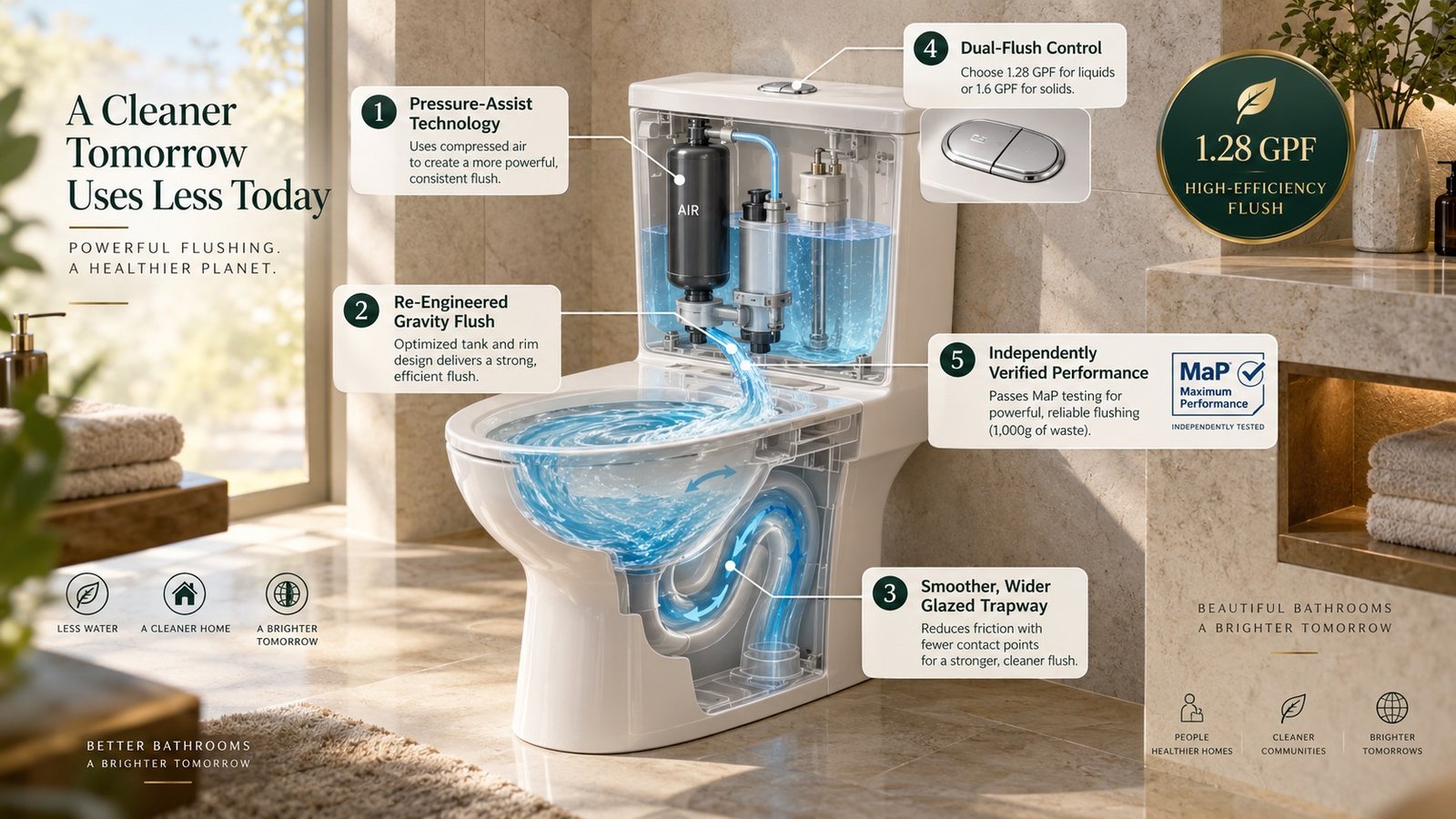
One of the most effective solutions replaces gravity alone with stored air pressure. Inside a pressure-assist toilet’s tank sits a sealed vessel rather than an open reservoir. As the vessel fills with water from the supply line, the air trapped above it gets compressed — essentially “charging” the tank using nothing more than ordinary household water pressure. When the toilet is flushed, that compressed air expands and forces the water into the bowl at a much higher velocity than gravity alone could achieve, often delivering the flush in just a few seconds. The result is a shorter, more forceful surge of water that can push waste significantly farther down the drain line than a standard gravity flush, reducing the need for a repeat flush even at lower water volumes.
Trade-off to know: Pressure-assist toilets are typically louder than gravity models due to the force of the air-driven flush, though newer designs have narrowed that gap considerably. They also require adequate incoming water pressure to charge properly.
Re-Engineered Gravity Flush Systems
Not every water-saving toilet relies on pressure assist — many of today’s best-performing low-flow models are still gravity-fed, but with meaningful design upgrades that early low-flow toilets never had. Wider flapper valves let water leave the tank faster, arriving in the bowl with more force in a shorter burst. Fully glazed trapways reduce internal friction, letting waste move through more easily with less water behind it. And engineers have paid much closer attention to the water’s actual path — minimizing sharp turns and directional changes inside the bowl and trapway so that flow stays smooth and efficient rather than turbulent and wasteful. Manufacturers sometimes describe this simply as an exercise in hydrodynamics: the same core gravity-flush concept, refined until it works reliably on a fraction of the water older designs required.
Fewer “Contact Points” in the Trapway
A key design principle behind high-performing water-saving toilets is minimizing the number of places where waste physically contacts the bowl or trapway surface as it travels through — often referred to as contact points. Every contact point adds friction and a chance for waste to snag or slow down, which matters far more when there’s less water available to push it along. By designing simpler, wider trapways with fewer directional changes, manufacturers reduce these friction points, which improves both the consistency of each flush and the toilet’s resistance to clogging over time — a benefit that shows up in both pressure-assist and modern gravity-fed designs.
Matching Water Volume to the Type of Waste
Dual-flush systems tackle the problem from a different angle: rather than trying to make every flush strong enough for solid waste, they let the user choose a reduced volume for liquid waste, which requires far less force to clear, and reserve the fuller flush volume for solid waste. This means the toilet doesn’t need to compromise its solid-waste flushing performance just to save water — it simply avoids using more water than necessary on the flushes that don’t need it. Combined with the trapway and flow improvements described above, a well-designed dual-flush toilet can maintain strong clearing performance on its full-flush setting while still cutting overall water use substantially across typical daily use.
How Flushing Performance Is Independently Verified
Because “flushes well” is otherwise a subjective claim, the industry relies on independent testing to make performance genuinely comparable across brands and technologies. MaP (Maximum Performance) testing is the most widely referenced program, measuring how many grams of solid waste a toilet can clear in a single flush under standardized conditions. A high MaP score gives buyers, specifiers, and reviewers an objective way to confirm that a water-saving toilet performs as well as claimed, regardless of whether it uses pressure-assist technology, a re-engineered gravity system, or a dual-flush design. For bulk buyers and commercial projects in particular, requesting MaP scores or equivalent third-party performance data is one of the most reliable ways to avoid a toilet that saves water on paper but disappoints in daily use.
Frequently Asked Questions
Are pressure-assist toilets better than gravity-flush toilets?
Not universally — pressure-assist toilets often deliver a stronger, more forceful flush and longer drainline carry, but they tend to be louder and require adequate incoming water pressure. Well-engineered modern gravity toilets can perform very reliably at low water volumes too, so the right choice depends on the project’s priorities around noise, water pressure, and budget.
Do water-saving toilets clog more often than older, high-volume models?
A well-engineered water-saving toilet, with an appropriately sized trapway and optimized water flow, generally clogs no more often than an older high-volume model. Clogging issues are more closely tied to design quality than to water volume alone.
What should I check before buying a water-saving toilet?
Look for a fully glazed trapway, confirm the flush technology (gravity, pressure-assist, or dual-flush), and check for an independent performance rating such as a MaP score, which offers an objective benchmark rather than relying on marketing claims alone.
FINAL THOUGHTS
The weak, double-flushing low-flow toilet is largely a relic of early water-efficiency mandates rather than an inherent limitation of using less water. Modern water-saving toilets close that gap through better engineering — whether that means compressed-air pressure assist, wider flapper valves and glazed trapways, smarter bowl hydrodynamics, or dual-flush systems that match water volume to the task at hand. For buyers, the takeaway is simple: water efficiency and flushing power are no longer a trade-off, as long as the underlying engineering — and its independently verified performance — actually backs up the claim.


评论
发表评论